Level 3 Physics Formula Sheet
January 16, 2026

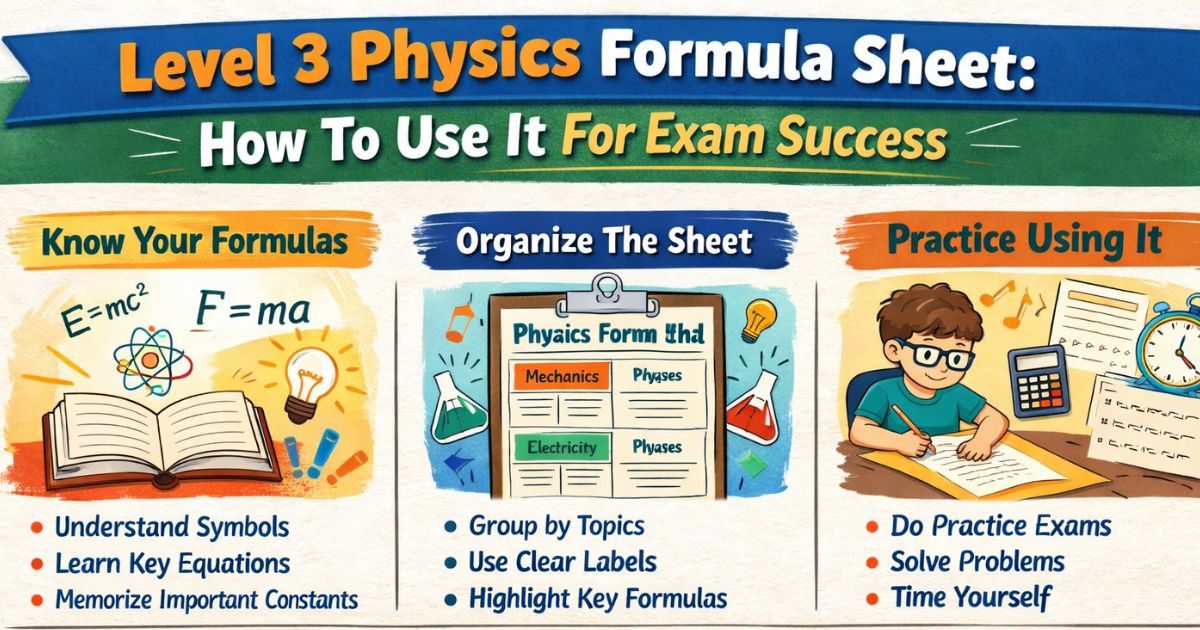
Hey everyone! So, you’re heading into Level 3 Physics and feeling a bit overwhelmed by all the formulas? Don’t sweat it. We’ve all been there. The good news is, there’s a tool designed to help you out: the Level 3 Physics formula sheet. Think of it like a cheat sheet for your brain. But just having it isn’t enough. You need to know how to use it, and use it well if you want to nail those exams. This guide is all about making that formula sheet your best friend for exam success.
Alright, let’s talk about the Level 3 Physics formula sheet. Think of it as your trusty sidekick during the exam. It’s basically a booklet provided by the exam board that lists a bunch of the key physics formulas you’ll need. It’s not meant to be a crutch, but rather a tool to help you focus on applying your knowledge.
Why does it matter so much? Well, physics exams can be pretty intense. You’re under pressure, time is ticking, and trying to remember every single formula for every possible scenario is a tall order. This sheet is designed to take some of that memorization burden off your shoulders. It means you can spend less time racking your brain for a specific equation and more time figuring out how to use it to solve the problem. It’s like having a cheat sheet, but a totally legitimate one that’s part of the exam itself.
Here’s a quick rundown of why it’s a big deal:
You’ll be given this sheet during the exam, but honestly, you should be using it constantly during your study sessions. Get super familiar with where everything is. It’s only useful if you know how to find what you need quickly.
It’s important to remember that the formula sheet doesn’t contain everything. Some basic formulas or definitions might be assumed knowledge. Plus, just having the formula isn’t enough; you need to know when and how to apply it correctly. Think of it as a toolbox – you wouldn’t bring a hammer to a screw job, right? You need to know which tool to pick for the task. You can find a comprehensive index of formula sheets to get a general idea of what’s out there, but your official Level 3 Physics sheet is the one that counts for your exam.
Alright, let’s talk about what’s actually on the level 3 physics formula sheet. It’s not just a random collection of equations; it’s designed to cover the core areas you’ll be tested on. Think of it as your essential toolkit for tackling problems across different physics topics. You’ll find formulas related to mechanics, waves, electricity, and modern physics. The sheet is your go-to for calculations, but knowing when to use each formula is key.
Here’s a general breakdown of what you can expect:
It’s important to remember that the level 3 physics formula sheet is a guide, not a crutch. While it provides the equations, you still need to understand the concepts behind them. For instance, knowing the difference between velocity and speed, or understanding the conditions under which a particular formula applies, is something you have to learn separately. You can explore more about the physics curriculum to get a better sense of the topics.
The formula sheet is structured to align with the major areas of study. Familiarising yourself with its layout will save you precious time during the exam. Don’t just glance at it; actively study where each formula is located and what it represents. This proactive approach makes a huge difference.
When you’re practicing, try to use the formula sheet as if you were in the exam. This means not relying on your memory for every single equation. Instead, focus on identifying the problem type and then locating the appropriate formula on the sheet. This builds confidence and efficiency. The goal is to make using the level 3 physics formula sheet second nature.

Okay, so you’ve got this formula sheet, right? It’s not just a random jumble of equations; it’s actually put together in a pretty organized way to help you out during the exam. Think of it like a well-stocked toolbox – you need to know where things are to use them effectively.
Most of the time, the formulas are grouped by topic. So, you’ll find all the mechanics formulas together, then maybe the electricity ones, and so on. This makes it way easier to find what you need when you’re staring down a question about, say, projectile motion. You won’t have to flip through pages of unrelated stuff.
Here’s a general idea of how it’s laid out:
It’s really important to get familiar with this structure before the exam. You don’t want to be wasting precious minutes trying to figure out if the formula for gravitational potential energy is under ‘Mechanics’ or ‘Energy’.
The formula sheet is designed to be a reference, not a crutch. Examiners expect you to know which formula applies to a given situation and how to use it correctly. Simply copying a formula down won’t get you marks; you need to show your working and apply it to the problem at hand.
Sometimes, you might also find a section with common constants or conversion factors. These are super handy and can save you from having to memorize them. Make sure you know if these are included on your specific Level 3 Physics formula sheet and where to find them. It’s all about making the exam process smoother so you can focus on solving the problems.
Okay, so you’ve got this formula sheet, right? It’s not just a fancy piece of paper to fill up space in your exam booklet. NCEA examiners actually want to see you using it, and using it smartly. Think of it like a toolbox; you wouldn’t just grab any tool for any job, would you? You’d pick the right one.
They expect you to demonstrate that you know which formula applies to a given problem and how to use it correctly. This means showing your working. Don’t just write down the final answer. Examiners want to see the steps you took, and that often starts with selecting the right formula from the sheet. If you just write down an answer without showing how you got there, you’re missing out on potential marks, even if your answer is spot on. It’s like saying you fixed the bike without showing anyone how you did it – they can’t be sure you actually know what you’re doing.
Here’s a breakdown of what they’re looking for:
Examiners aren’t mind readers. They can only assess what you write down. Showing your working, including the formula you used from the sheet, is your way of communicating your thought process and demonstrating your understanding of the physics principles involved. It’s your chance to prove you know your stuff, even if the final number isn’t perfect.
Remember, the formula sheet is a tool to help you, not a crutch. Using it effectively is a skill in itself, and it’s one that examiners are definitely assessing. So, get familiar with it, practice using it, and make sure you’re showing all your work when you use those formulas to get the best possible total score for your exam.
Alright, let’s talk about what’s actually on that Level 3 Physics formula sheet. It’s not just a random collection of equations; it’s designed to cover the big areas you’ll be tested on. Think of it as your cheat sheet for the main events in Level 3 Physics.
Here are the major topics you’ll find formulas for:
The sheet is your guide to these core concepts, but remember, it won’t explain how to use them or the theory behind them.
Okay, so you’ve got this formula sheet, right? It’s supposed to be your best friend during the exam, but sometimes, people mess it up. It’s not just about having it; it’s about using it right.
One big oopsie is not showing your work. Seriously, examiners aren’t mind readers. They need to see how you got to that answer. Even if your final number is a bit off, showing the correct steps and formula can get you partial credit. So, write down the formula you picked, how you rearranged it, and what numbers you plugged in. It’s like showing your homework – it proves you know what you’re doing.
Another common pitfall? Units. It’s super easy to mix up kilometres with metres, or grams with kilograms. If you throw the wrong units into a formula, your answer will be way off, and you might not even realize it. Always double-check those units before you start calculating. And remember, if it’s a vector quantity like velocity, you need a direction too!
Here are some other things students often get wrong:
The formula sheet is a tool, not a crutch. Relying on it too much without understanding the underlying concepts means you’ll struggle when a question requires a bit more thought or a combination of formulas.
Don’t just blindly copy formulas. Understand what each variable means and when that specific formula applies. It’s all about smart application, not just finding a match.
Okay, so you’re in the exam, the clock’s ticking, and you need a specific formula. Panicking won’t help, right? The key here is familiarity. Think of the formula sheet like your toolbox – you wouldn’t fumble around for ages looking for a screwdriver if you knew exactly where it was.
The more you practice with the sheet before the exam, the faster you’ll be able to locate what you need. It sounds obvious, but seriously, don’t just glance at it. Use it during your study sessions. Try to get a feel for where different topics are grouped. Is mechanics usually at the front? Is electricity towards the back? Knowing the general layout is half the battle.
Here’s a breakdown of how to get speedy:
Don’t just rely on the sheet to give you the answer. You need to know which formula to pick based on the information given in the question and what you’re asked to find. The sheet provides the tools; you need to know which tool to use for the job.
Think about it: if you’re asked to calculate acceleration and you’re given initial velocity, final velocity, and time, you’ll be looking for a formula that connects those three. A quick scan of the ‘Kinematics’ section should get you there if you’ve practiced. It’s all about building that connection between the problem and the resource.

Alright, so you’ve got this formula sheet, right? It’s not just a random collection of equations; it’s your cheat sheet for tackling those physics problems. But just having it isn’t enough. You need a plan.
First off, read the question. Seriously, I know it sounds obvious, but people skip this. What are they actually asking for? What information are they giving you? Underline keywords and jot down the knowns and unknowns. This is like being a detective – gather your clues.
Next, scan the formula sheet. Don’t just stare at it blankly. Look for formulas that connect the things you know to the things you need to find. Think about the variables involved. Does a formula have ‘v’, ‘u’, ‘a’, and ‘t’? If you know three of those, you’re probably on the right track to finding the fourth.
Here’s a little breakdown of how to approach it:
Remember, the formula sheet is a tool, not a crutch. You still need to understand the physics behind the equations. Examiners want to see that you can pick the right tool for the job and use it correctly, not just blindly copy a formula.
Don’t be afraid to try a formula, see if it works, and if not, try another. It’s a process of elimination and application. The more you practice, the faster you’ll get at spotting the right equation for the job.
Okay, so the formula sheet is super handy, right? It’s like a cheat code for your physics exam. But here’s the thing: it’s not a magic wand. There are definitely times when leaning on it too much can actually hurt your score.
First off, don’t treat it as a substitute for actually learning the concepts. If you don’t understand why a formula works or what its variables mean, just plugging numbers in won’t get you far. Examiners can spot that a mile away. They want to see that you grasp the physics, not just that you can find a formula and copy it down. Think of it like having a recipe book – you can follow the steps, but if you don’t know what ‘sauté’ means, you’re going to have a bad time.
Here are a few situations where you need to be careful:
Relying solely on the formula sheet is like trying to build a house with only a hammer. You need a whole toolbox of knowledge, and the formula sheet is just one tool within it. Use it to support your learning, not replace it.
Also, remember that exam rules are strict. You can’t write anything extra on the formula sheet itself, like personal notes or reminders. It has to be exactly as provided. Trying to sneak in extra info can get you into trouble, so stick to the official formula sheet provided.
Okay, so you’ve got the formula sheet, but just having it isn’t going to magically get you an A. You need to actually use it, and not just during the exam. Think of it like a toolbox; you wouldn’t wait until you’re in the middle of a plumbing emergency to figure out which wrench to use, right? Same idea here.
The absolute best way to get good with the formula sheet is to practice with it constantly. Seriously, every time you do practice problems, use the sheet. Don’t just rely on what you remember. This helps you in a few ways. First, you get super familiar with where everything is. No more frantic flipping when you’re under pressure. Second, you start to see which formulas are used for what types of problems. It’s like learning the specific tool for each job.
Here’s a breakdown of how to make practice time really count:
Don’t just passively look at the formula sheet. Actively engage with it. Try to solve problems without looking at your notes first, and only then use the sheet to confirm or find the formula if you’re stuck. This builds your problem-solving muscle memory.
It might feel slow at first, but the more you integrate the formula sheet into your regular study routine, the more natural it will become. By exam day, using it will feel like second nature, not a last-minute scramble.
Top students don’t just glance at the formula sheet during the exam; they treat it like a well-organized toolbox they’ve built themselves. They’ve spent time before the exam getting intimately familiar with it. This means they know exactly where to find each formula, what each symbol means, and in what context it’s typically used. They don’t waste precious minutes flipping pages or searching for a specific equation.
Instead of just passively accepting the provided sheet, they often augment it. They might add key definitions, common problem-solving steps, or even small diagrams that clarify complex concepts. Think of it as a personalized cheat sheet built on top of the official one. This customization helps them connect the abstract formulas to concrete problem-solving strategies.
Here’s a breakdown of how they approach it:
The formula sheet isn’t a crutch; it’s a launchpad. Top students use it to quickly access the building blocks, but their real skill lies in knowing how and when to assemble those blocks to solve complex problems. They’ve practiced applying these formulas in countless scenarios, so the sheet simply serves as a quick reference, not a primary learning tool during the exam.
They also understand the limitations. If a formula isn’t on the sheet, they know they’re expected to derive it or recall it from memory. They don’t assume everything will be provided. This proactive approach, combining familiarity with the official sheet and strategic augmentation, is what allows them to perform at their best when the clock is ticking.

Alright, exam day is here! You’ve studied hard, and now it’s time to put that formula sheet to work. Think of it as your trusty sidekick, not a crutch. The biggest thing is to stay calm and focused.
Here’s a quick rundown of how to make the most of it when the pressure’s on:
Don’t get bogged down trying to find a formula for every single thing. Sometimes, the simplest approach is best, and you might already know the relationship by heart. The formula sheet is there to help, not to make you second-guess yourself.
Remember to check your calculator settings and make sure you’re answering to the required number of significant figures. A little bit of preparation with the formula sheet during your study sessions will make a huge difference on the day. Good luck with your AP Physics exam!
Getting ready for your Level 3 Physics exam? Don’t let the formula sheet stress you out! We’ve got some super helpful tips to make sure you can use it like a pro on exam day. Want to ace your physics test? Check out our website for more study secrets and resources!
Think of the Level 3 Physics formula sheet as a handy cheat sheet provided for your exams. It’s a list of important equations and formulas that you’ll likely need to solve problems. It’s there to help you out, so you don’t have to memorize every single equation perfectly.
This sheet is super important because it saves you time and stress during the exam. Instead of trying to remember every single formula, you can quickly find the ones you need. Knowing how to use it well can make a big difference in how many questions you can answer and how well you do.
Not always! While it has most of the common and important formulas, sometimes you might encounter questions that need formulas not listed. It’s a good idea to learn some extra key formulas yourself, especially those you use a lot or that are central to certain topics.
The best way to get good with the formula sheet is to use it while you study and do practice problems. Treat it like it’s the real exam. Try to find the right formula quickly and practice plugging in the numbers. The more you use it, the faster and better you’ll become.
If you’re looking for a formula and it’s not there, don’t panic! It might mean you need to use a combination of formulas you find, or perhaps it’s a concept you’re expected to know without a direct formula. This is where understanding the core ideas of physics really helps.
Yes, definitely! Some students spend too much time searching for formulas, or they use the wrong one. Others might not understand the units or forget to rearrange the formula correctly. A big one is not showing your work when using a formula, which can cost you marks.
Get organized! The formula sheet is usually grouped by topic. Before the exam, spend time looking through it and noting where different types of formulas are located. Practice makes perfect – the more you flip through it during study, the faster you’ll be during the actual test.
First, read the question carefully to understand what it’s asking. Then, find the formula on the sheet that matches the situation. Make sure you understand what each symbol in the formula means. Write down the formula, rearrange it if needed, and then carefully substitute the numbers with their correct units.


